Over the last several weeks, our office has received many calls about the beautiful white trees that are in bloom right now. In short, those trees are Callery Pears (Pyrus calleryana Decene) – an Asian ornamental pear often sold under the name of Bradford, Chanticleer, Cleveland Select, Autumn Blaze, or Aristocrate. While they may be beautiful and give us a glimpse of springtime on the horizon, they are increasing as an environment and land management concern as an invasive species.
Callery Pears
(Updated: March 18, 2024, 11:41 a.m.)
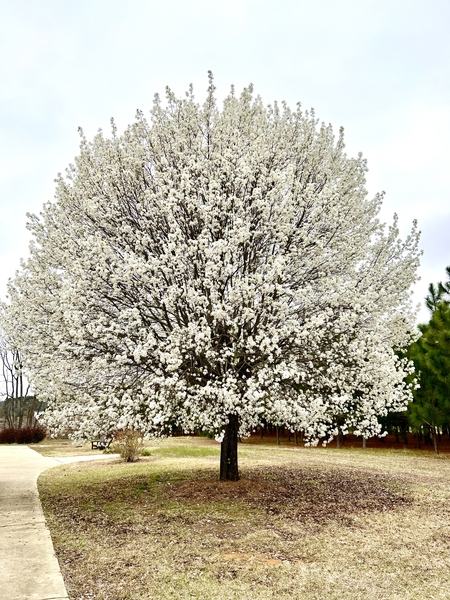
The ‘Bradford’ Pear became popular in the landscape because of its early bloom of white blossoms, ability to adapt to poor soil conditions, low maintenance, and symmetrical shape. The downside is the pungent odor emitted from the flowers that is produced that has been described to be similar to rotting fish, as well as the tree’s branch structure which is fast growing leading to unstable and weak unions causing it to break under its weight in mild to moderate storms.
And while the Bradford itself is sterile and unable to pollinate with itself, other variations of the Callery pear (such as Autumn Blaze) or shoots that grow from the rootstock of the Bradford, pollination becomes possible, creating a path for seed that is consumed by birds which then gives way to “wild” Callery pears which take over roadsides, agriculture fields, unmanaged lots, and forest lands. These wild Callery pears are easily spotted because of their early bloom of white flowers against the bleak winter landscape. Because of their early bloom and leaf timing, they tend to shade out native plants, essentially choking them out of the landscape, forming dense thickets in forests and landscapes, and decreasing food sources for herbivores. The ‘wild’ version also features large thorns, causing them to form thorny thickets that prevent wildlife from moving through the landscape and using the trees as a cover.
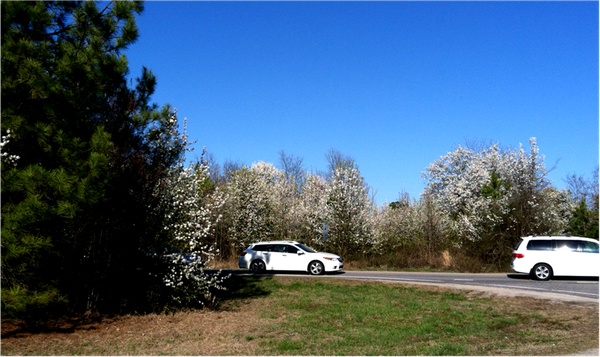
Source: Kelly Oten
Some states have recognized the ecological impact that Callery pears are having on the environment and are taking action to ban them from being sold. South Carolina, for example, will have a ban implemented in 2024 against selling Callery pears. However, this will not affect those already planted in the landscape. Other states, such as North Carolina, have launched ‘bounties’ against the Callery Pear. More info on the NC Bradford Pear Bounty can be found at treebountync.com.
Landowners with any variety of Callery pears are encouraged to remove and replace them with native species to reduce their spread. North Carolina has several natives that are similar and will enhance the landscape and provide the same aesthetic value as the Bradford/Callery pear. Two great examples are dogwood and eastern redbud.
More info on Callery Pears can be found here.
Join our mailing list!
Enter your email address to receive updates.
Written By

More About