by Eleanor Moyer, Clay County Master Gardener
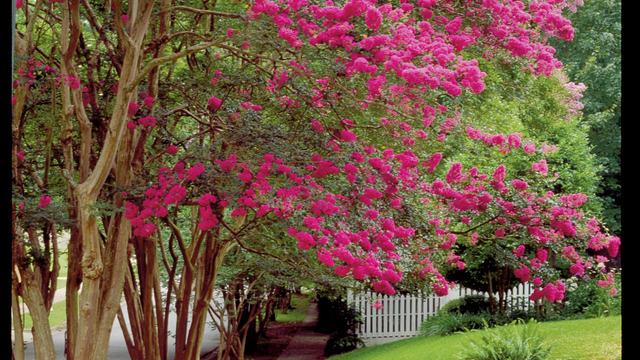
Had my daughter from Charleston visit last week who complained vociferously about the crape myrtles she took down that keep sprouting all over her yard. I told her to just keep at it, they will eventually give up, but you must love a plant with that much gusto! She had to remove them because a previous owner planted them too close to the house where their messy, shedding flowers stained a deck—right plant, wrong place. That is one main caveat for this beautiful plant. Before you buy, look at the tag and do a bit of research. If you want a 10-foot tree, don’t plant one that will get 30 feet, or it will be “murder” to control it!
Crape myrtles (Lagerstroemia) were brought to Charleston in the late 18th century from China where it was called “Pai Jih Hung” for its beautiful color and long bloom season. In the 50’s 5 Japanese seedlings (L. fairies) were planted at NC State University where the Arboretum now stands. These were crossed with those growing the US (L. indica) at the National Arboretum to produce new cultivars that are more disease resistant and vigorous. These are the Native American species like ‘Natchez’ and ‘Hopi’. Since then, there has been an ongoing race to hybridize the plant for size, color, disease resistance, and vigor. The 90’s brought the black-leafed varieties like ‘Black Diamond’ and ‘Magic’ series of cultivars. In the early 2000’s chocolate brown leafed varieties were developed that have been named ‘Delta Jazz’. If you want to try to get into this race, Crape myrtles are easy to grow from seed or soft wood cuttings.
These plants grow from 3 to 30 feet. Their shapes range from upright/ vase (taller than wide), rounded/globose (wide as tall), spreading (wider than tall) to weeping. A good rule of thumb is to add 30% to whatever the tag lists as height and width. So, a 6-foot tree might actually grow to 7.8 feet. They prefer good draining soil with adequate moisture although they can withstand drought once established. Crape myrtles do need 8 hours of full sun and good air flow for abundant flowers. They have aggressive root systems (see above) that may be difficult to garden under. They are deer and rabbit resistant and offer beautiful fall color. Their mottled exfoliating bark can be reason enough to have one in your garden. Despite being non-native, they attract many pollinators. The flowers can be used in arrangements although they are prone to dropping petals.
There are problems of course. Clemson Extension has an online article “Crape myrtle Diseases and Pests” with good pictures. Their opening line: “The most effective control measures include locating plants in full sun, removing sprouts from the base of the plant and planting disease resistant varieties is sound advice”. Bark scale isn’t much of a problem here yet, but western Tennessee is seeing more cases.
I simply can’t imagine a summer without these beautiful trees and shrubs. Happy gardening.