By: Eleanor Moyer, Extension Master Gardener Volunteer of Clay County
I recall the first time a gardener showed me how to harvest marigold seeds. I was a child with limited resources, so it really opened up new possibilities for my gardening piggy bank!
If you look around our beautiful county, most of the trees, grasses, and wildflowers weren’t planted by someone, but by Mother Nature. All those big seed companies get their seeds the same way you and I can, well perhaps with a bit more technology and scientific expertise, but we can do it for free! This is the perfect time to start.
Flowers are the easiest and best way to begin with annuals such as marigolds, zinnias, cosmos, mallows, cleomes, California poppies, and black-eyed susans prime specimens.
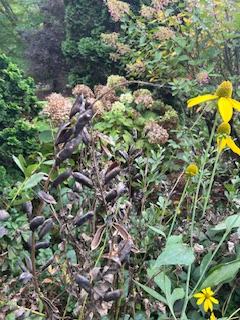
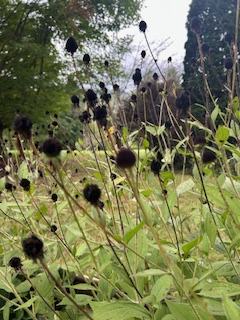
Timing is of most importance. You want to wait until the flower has faded and the seed, pod, or fruit has dried, but is not rotten. Choose a dry, sunny day to harvest. Snip the flowers into a container like a brown lunch bag, envelope, or bowl. Make sure you keep each plant variety separate and label when completed. You might distinguish between zinnia and marigold seeds, but not every seed will be as unique. Keep the seeds away from moisture by laying on paper towel, newspaper or leaving in the paper bag until completely dry. You will need to remove husks by hand. Most of the annual seeds can be removed by pulling out the seeds from the flower. There are lots of videos online to demonstrate this. The chaff is another matter as the techniques vary by type of seed. Dropping seeds down onto paper may remove some light debris. Shaking through a colander or sieve is another. Just thinking of zinnia seeds that may have dried flower petals attached for instance, you can store it all as long as it is dry. There will be a need to sow more heavily because of the extra “stuff”, but it will not alter viability. Then package, label and store the seeds in a cool, dry place. There are small brown envelopes that serve well, but old medicine containers, the brown bags used for harvesting, plastic baggies or containers, mason jars, etc. are suitable. There will not be the same viability as packaged seeds, but you are not loosing anything either. Not all the seeds may look like its parent as cross pollinating may have occurred, but you may be fortunate to develop a unique variety! Come Spring, you will have free seeds to start indoors, sow directly in the garden or swap with friends. Once you begin, there is no end to possibilities. Those basil flowers contain seeds, dill, tomatoes, grass fronds and perennials all can be grown from gathered seeds. We have a member who grows wild-flame azaleas from seed.
There are other ways to create new plants for your garden. Clay County Master Gardener Volunteers is offering a free class on How to Divide and Pot plants at the Downtown Discovery Garden, October 17 at 10 am. It is being taught by an excellent gardener who is renowned for her plant proficiency. Participants can learn hands-on. Bring a plant or use one from our garden. Space is limited. Please register at: go.ncsu.edu/claydp25.