I do love to work in the garden, but despite my best efforts there is always
something that doesn’t turn out as I had hoped. I live next to a vacant
property that is only worked by mother nature and darn if she doesn’t do a
great job with no effort at all! (Think there might be a biblical reference to
that point.) Iron weed, sunflowers, assorted grasses, just blossom away.
So if you can’t beat’m then join them! Here are a few native plants that will
reward you with late season color.
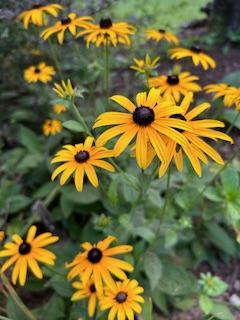
Black eyed Susan, Rudbeckia hirta, is a short-lived perennial/annual that
glows with lovely yellow petals circling a dark center. In the words of some
of my gardener friends “anyone can grow it.” Well, that is an excellent point
in its favor! It grows best in full sun, but can take some shade. It spreads
by self seeding and underground rhizomes. The flowers and roots made
into medicinal teas and compresses by Native Americans treated a variety
of illnesses-snake bites, worms, earaches, indigestion, burns and sores.
There are native varieties over much of America even ones admired during
Lewis and Clark’s Voyage of Discovery. The stems and leaves are covered
in tiny barbed hairs to make climbing upon by ants and other insects
extremely uncomfortable. The blooms provide nectar for all kinds of
pollinators and the dry seed heads are food sources for birds during
Autumn and Winter.
Maryland deemed it their state flower in 1918 and new varieties are coming
on the market each season. All-American Selections (AAS) tests new
plants annually to select winners with superior garden performance. The
2020 AAS winner is rudbeckia x American Gold Rush which sports shorter
stems and smaller foliage. Allan Armitage, professor at UGA and a native
plant expert, offers Rudbeckia Indian Summer, 1995 AAS winner, as his
choice. The huge blossoms are 6 to 9 inches across! I purchased a
variety called “Irish Eyes” many years ago and it has delighted me ever
since. I simply snip off flower heads in fall and scatter them about, but
harvesting the seeds from the dried cones (eyes) is an easy process and
will offer more control. Store the seeds in a paper envelope in a cool dry
place for germination in the spring. The cut flowers are lovely in
arrangements with a bit of lemon juice to prolong longevity.Another interesting choice is lobelia siphilitica, Giant Blue Lobelia. As long
as it gets enough moisture, it is another easy-to-grow plant that is loved by
bumble bees, butterflies, hummingbirds and other pollinators. If you have a
moist area in the garden with sun or shade this is the plant for you. I’ve
had success however even with our drought/deluge summer this year. It is
deer and rabbit resistant with tall, beautiful stems of blue flowers. Its name
is derived from its purported use as a treatment for syphilis. North Carolina
native, Thurman Maness, is a lobelia guru and has developed many
varieties. It was selected as the 1993 NC Wildflower of the Year.
Happy gardening!
Natives for Late Summer
(Updated: Aug. 29, 2024, 12:17 p.m.)
Join our mailing list!
Enter your email address to receive updates.
Written By