By: Eleanor Moyer, NC State Extension Master Gardener℠ Volunteer – Clay County.
Well, early spring has sprung with loads of beautiful trees just bursting with loveliness. There is one wolf in sheep’s clothing among them, however— Bradford Pears! They are pretty, but their flowers stink. They offer some nectar for bees, but not enough for their preference. They are short-lived and vulnerable to damage in storms, and most importantly, they displace our more valuable native trees. NC State Extension has offered a Bradford Exchange, which I hope they will repeat next year, where a native tree is provided for a cut-down Bradford. You can take initiative now and create your own exchange. Here are a few of the beautiful native choices.
Parsley hawthorn (Crataegus marshallii) is a beautiful small tree or shrub growing to about 25 feet. It has dainty white flowers followed by bright-red fruit (haw), providing food for birds. It is adaptable to most of our soils, including moist, well-drained areas near ponds and streams in full to part sunny areas. Its small leaves resemble parsley. The stems have decent-sized thorns, which provide an excellent nesting area for songbirds.
One of my personal favorites is Serviceberry (Amelanchier arboea.) This is another smallish tree or shrub growing 15 or 20 feet in full sun to partial shade in most any of our soils. It is showing off its fragrant white flowers now, which are followed by purple fruit similar to blueberries. If you can harvest them before the birds devour each one, they make lovely additions to pies, jams, and preserves. I know they must be delicious because I found a black bear sampling its wares one spring. The variety ‘Autumn Brilliance’ has particularly vibrant fall foliage. Its name has an interesting story. In days gone by, a body could not be buried until the ground thawed, which happens when this tree blooms, so the ‘services’ would be held. Another name is Shadbush because its bloom time coincides with the running of shad fish.
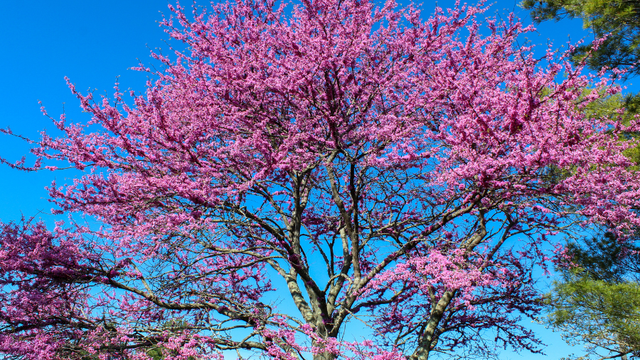
Eastern Redbud (Cercis canadensis) is a showstopper! In fact, it's the state tree of Oklahoma. The pink/purple pea-like flowers blooming now cover the trunk and stems and are a magnet for pollinators. They are edible both raw and in cooked dishes. The heart-shaped leaves follow, offering lovely shade in this approximately 25-by-25-foot small tree. Seed pods develop that look like pea pods because it belongs to the same botanical family, Fabaceae, as peas. Some folks object to the litter they cause, but the pods are food for birds and squirrels. The hybridized varieties usually have few or none. One of my favorites is ‘Forest Pansy’, sporting lovely purple leaves all summer. A Texas variety, ‘Merlot’, offers better heat tolerance. ‘Lavender Twist’ is a weeping variety. The leaves of ‘Hearts of Gold’ are yellow, gold, and green at the same time. Newly planted trees can be pruned and fertilized in late winter.
I’ll close with a beautiful tree that would serve a woodland area of your garden, Red Buckeye (Aesculus pavia.) It is another small tree blooming a bit later than the aforementioned. Its reddish stem sports large palmate leaves, giving it a somewhat lush, tropical look. The 8-inch-long red flower clusters emerge to welcome newly arrived hummingbirds. Seeds are beloved by squirrels and other mammals, but not suitable for humans. Native cultures used the seeds and branches to stun fish. It loses its leaves early, so bear that in mind when placing it in your garden. Happy planting!