by Eleanor Moyer, Extension Master Gardener, Clay County Volunteer
Keep your face to the sunshine and you cannot see the shadow. It’s what sunflowers do. Walt Whitman
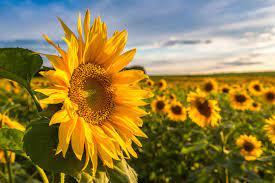
August is the season for sunflowers. I can remember marveling at an entire farm field filled with sunflowers when I was younger, only to discover that it was a bait field for dove season which didn’t seem very sporting to me! Besides their cheery beauty, the flowers are an important agricultural commodity producing the second most important seed oil. Seeds generate 35 to 40% oil which is high in polyunsaturated fat with no cholesterol. Currently, there is a debate about using seed oils, with some claiming that their omega 6 fatty acid content promotes inflammation. My claim to scientific knowledge about this is nil, but I would advise you to do research from reputable sources before jumping on any bandwagon.
The genus name, Helianthus, comes from the Greek: helios (sun) and anthem (flower). It is native to the Americas and was once an emblem of the Inca Sun God. It is the Kansas state flower but is classified as a noxious weed in Iowa-go figure! There are both annual and perennial varieties that range in height from 2 feet to over 10 with flowers that can reach 2 feet in diameter! Almost all the varieties should be planted at the rear of the border where staking may be required. Perennial kinds spread rapidly and may become invasive in your garden. They make great cut flowers. Cut the blooms on a diagonal just when the begin to open to extend vase life.
Since they are heliotropic plants that follow the sun, they must have it—at least six hours. Plant seeds when the soil has warmed up in May, about 1/2 inch deep (depending on variety) and water in well. Thin the plants when they are a few inches high. They are drought tolerant once established.
Helianthus annuus is the common annual sunflower. ‘Mammoth Russian’ is an old variety with enormous flowers. A newer variety ‘Kong’ offers equal bigness. These make excellent seed flowers. Harvest when florets in the center have shriveled and the back of the flowerhead is turning yellow. Leave one foot of stem and hang in a warm, dry, well-ventilated space. Protect the flowerhead with cheesecloth or a brown bag with ventilation slits. The flowers and seeds are magnets for birds, pollinators, small mammals and lovers of beauty. Those that are grown for flowers come in two varieties: pollen-bearing and pollenless. ‘Indian Blanket’ is one example of pollen-bearing. Pollenless varieties don’t shed on table tops and are classified as H. x hybridus. ‘Bright Bandolier’ is a bicolor example.
Helianthus ‘Lemon Queen’ is a perennial variety that is covered with numerous pale-yellow flowers that have brown centers. It can be 6 to 8 feet tall and likes moist or dry soil. ‘Capenock Star’ caught my eye when watching an English video. It grows 4 to 6 feet tall with a plethora of luminous yellow blooms. Happy gardening!