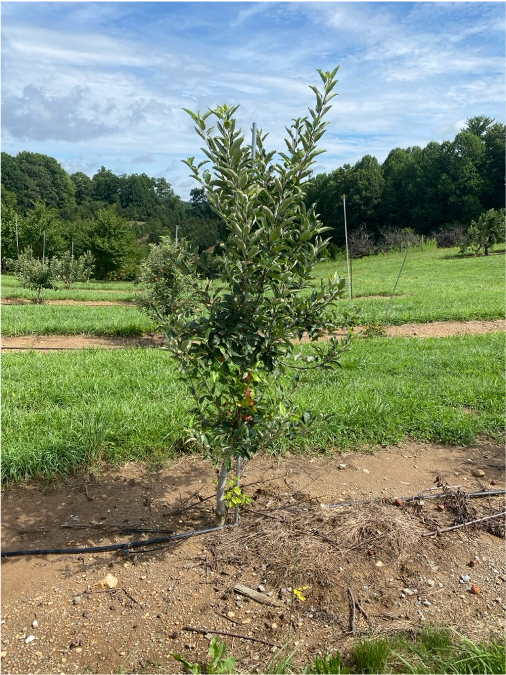
Have you thought about enhancing your garden or landscape with apple trees? Not only do they produce delicious fruit perfect for baking, canning, selling at farmers markets, or simply enjoying fresh from the tree, but they also offer vital habitat and food sources for wildlife, including birds, bees, butterflies, and other pollinators.
Apples have a long history in the southern US, dating back to the 1600s. Many of the
old southern apple varieties, estimated at over 1,800, are now extinct. However, there
are some still available that continue to thrive in our hot, humid climate.
One important aspect to remember when planting apple trees is their self-
incompatibility. This means they cannot cross-pollinate with the same variety and
require pollen from another variety to produce fruit. Additionally, the two varieties must bloom simultaneously. For instance, a Gala and Granny Smith can cross-pollinate, but a Gala and Golden Delicious cannot, due to their differing bloom times.
Choosing the right site for your apple trees is crucial. Ensure the area receives full sun
and is free from shading by surrounding trees or buildings and will receive good air
circulation. It’s also important to have well-drained soil and avoid areas prone to frost
pockets, which can damage buds during the budding season. To confirm your soil’s
suitability for apple trees, you can get it tested for free from April to November at the
extension office and find out if any amendments are needed. For areas below 2500 ft in elevation, you can plant trees in the fall before the frost. However, it is best to do it in early spring while they are still dormant, usually around Mid-March – April. Depending on when you choose to plant, it is always important to plant ahead on what varieties you will use and the site location.
One issue we have in our area is the deer love to eat the apples before they are ready to be harvested. If this is something you want to prevent, you may consider building a high fence around the trees or installing a barrier, such as plastic or woven wire cylinder to help deter them. Loud noises often only work for a short time, as they become used to this once they realize it is not a danger – and your neighbors may not appreciate the disruptions. Other options include fragrant soap hung from outer branches every 3 feet (replaced as needed) or chemical repellants (although some are not safe for food production so read the label carefully before use). Old wives tales say to use human hair or rotting eggs to provide an unfamiliar or unpleasant scent; however, no research has been done to validate this. Using mothballs (naphthalene) is not recommended and is illegal to manage deer populations. It is also poisonous if eaten by small children and pets.
Our region offers a variety of apple options. Traditional favorites include Gala, Red
Delicious, Golden Delicious, Fuji, and Pink Lady. For those looking for a more unique
option, non-traditional varieties such as June Apple, Hunge, Grimes Golden, or
Arkansas Black are good choices and reminiscent of varieties of days gone by. The
varieties you select will determine the harvest time for your apples.
NC State has great resources for anyone wanting to plant apple trees. You can visit our website clay.ces.ncsu.edu or stop by our office at 25 Riverside Circle, Hayesville for more info.
N.C. Cooperative Extension extends research-based knowledge to all North Carolinians, helping them transform science into everyday solutions that improve their lives and grow our state. For more information on what services we provide, visit N.C. Cooperative Extension, Clay County Center, at 25 Riverside Circle, Suite 2, Hayesville, NC 28904, call us at (828) 389-6305..